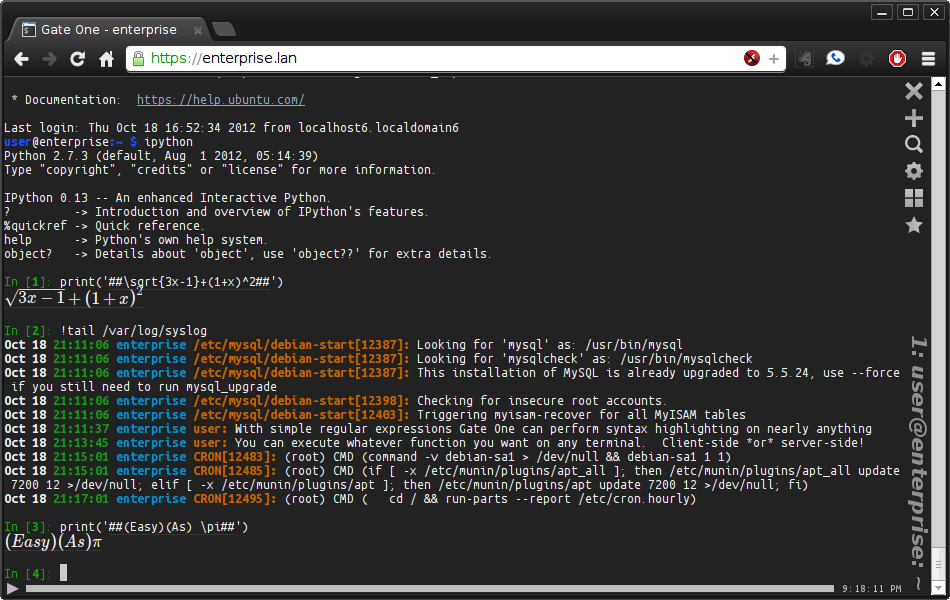
Poderosa (“powerful” in Spanish) is a well-build terminal emulator that is able to handle Telnet, SSH, FTP, and CYGWIN connections. Additionally, it can be used to create serial connections by using the COM ports of your computer. It comes with all the tools that users might need, and it is open-source. Xterm is the oldest Terminal emulator, which is for X Window. Xterm is the best graphical Linux terminal tool. This is a great terminal emulator for Linux users. 10)LilyTerm Terminal: LilyTerm is the Best Linux Terminal Emulator, which is an open source terminal. LilyTerm has many standard options and features.
| Developer(s) | Apple Inc. |
|---|---|
| Operating system | macOS |
| Platform | x86-64, IA-32, PowerPC |
| Type | Terminal emulator |
| Website | www.apple.com/macosx/features/unix/ |
Edit video using photos for mac. Terminal (Terminal.app) is the terminal emulator included in the macOSoperating system by Apple.[1] Terminal originated in NeXTSTEP and OPENSTEP, the predecessor operating systems of macOS.[2]
As a terminal emulator, the application provides text-based access to the operating system, in contrast to the mostly graphical nature of the user experience of macOS, by providing a command line interface to the operating system when used in conjunction with a Unix shell, such as bash (the default shell in Mac OS X Jaguar and later[3]).[4] The user can choose other shells available with macOS, such as the Korn shell, tcsh, and zsh.[4][3]
The preferences dialog for Terminal.app in OS X 10.8 (Mountain Lion) and later offers choices for values of the TERM environment variable. Available options are ansi, dtterm, nsterm, rxvt, vt52, vt100, vt102, xterm, xterm-16color and xterm-256color, which differ from the OS X 10.5 (Leopard) choices by dropping the xterm-color and adding xterm-16color and xterm-256color. These settings do not alter the operation of Terminal, and the xterm settings do not match the behavior of xterm.[5]
Terminal includes several features that specifically access macOS APIs and features. These include the ability to use the standard macOS Help search function to find manual pages and integration with Spotlight.[citation needed] Terminal was used by Apple as a showcase for macOS graphics APIs in early advertising of Mac OS X,[citation needed] offering a range of custom font and coloring options, including transparent backgrounds.
See also[edit]
- iTerm2, GPL-licensed terminal emulator for macOS
- Terminator, open-source terminal emulator programmed in Java
References[edit]
- ^'What Is Mac OS X - All Applications and Utilities - Terminal'. Apple Inc. Archived from the original on May 10, 2013.
- ^Wünschiers, Röbbe (January 1, 2004). Computational Biology: Unix/Linux, data processing and programming : with 19 figures and 12 tables. Springer Science & Business Media. ISBN9783540211426.
- ^ abKissell, Joe (January 1, 2009). Take Control of the Mac Command Line with Terminal. TidBITS Publishing, Inc. ISBN9781933671550.
- ^ abMcElhearn, Kirk (December 26, 2006). The Mac OS X Command Line: Unix Under the Hood. John Wiley & Sons. ISBN9780470113851.
- ^'nsterm - AppKit Terminal.app', terminfo.src, retrieved June 7, 2013
| Wikimedia Commons has media related to Terminal (OS X). |